
India produces media data at an unprecedented scale. From television and print to digital platforms, influencer content, and social media, brands today are surrounded by constant streams of information.
But access to data is no longer the challenge.
The real issue is clarity.
Campaigns run simultaneously across paid, earned, and owned channels. Conversations shift rapidly between platforms. Regional languages reshape meaning. Influencer narratives can amplify or distort perception within hours.
In this environment, more data does not create better insight. It creates noise.
The key question for brands is: How do you separate signal from noise and turn it into decisions that drive business outcomes?
The Role of Paid, Earned, and Owned Media in India
Most modern media strategies are built around the Paid, Earned, and Owned (POE) framework. Indian brands are no exception. However, the way these channels interact in India is far more complex than in many global markets.
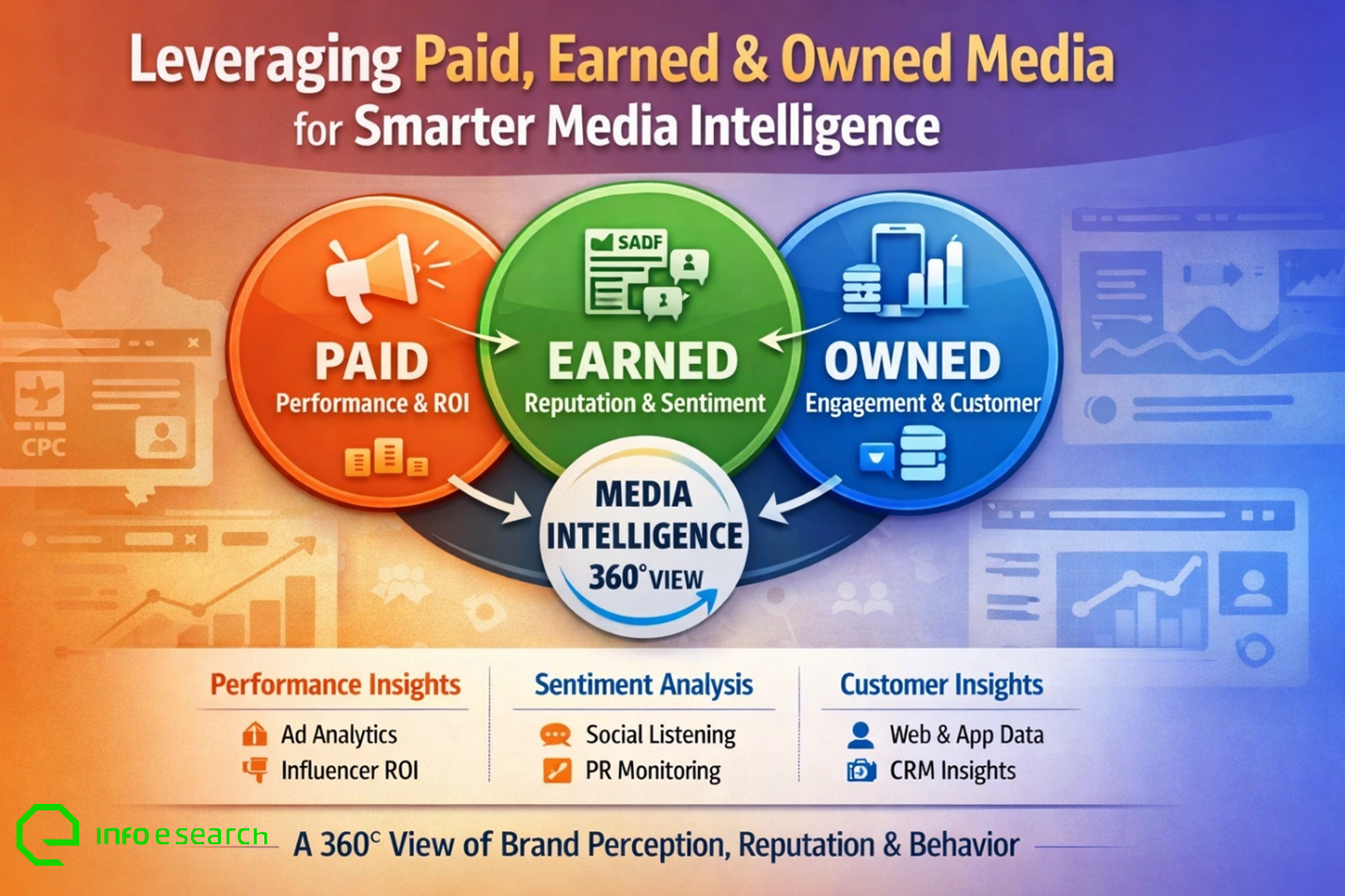
1. Paid media includes digital ads, sponsorships, and influencer collaborations. It drives reach, targeting, and measurable performance metrics such as cost per acquisition (CPA) and conversion rates.
2. Earned media includes press coverage, social mentions, user-generated content, and organic influencer activity. It reflects public perception, sentiment, and credibility.
3. Owned media includes websites, apps, CRM systems, and brand-managed social channels. It captures first-party data such as user behavior, engagement, and customer journeys.
Individually, each of these channels provides valuable data. Together, they create a comprehensive view of brand performance.
However, in India, these channels do not operate in isolation. They interact dynamically, influencing each other in real time.
Understanding the Complexity of the Indian Media Landscape
India’s media environment is uniquely complex.
1. Multiple languages influence how content is interpreted
2. Regional markets behave differently from national trends
3. Social media, television, and print coexist as major influence channels
4. Meme culture and influencers can shift sentiment rapidly
5. Closed networks like messaging platforms contribute to unseen narratives
This creates a critical challenge:
The same campaign can generate different meanings across regions and audiences.
While AI can process large volumes of multilingual data, it often struggles with context, cultural nuance, and intent.
Without proper interpretation, insights can become misleading.
Why Traditional Media Monitoring Falls Short
Many media monitoring and analysis systems focus on:
1. Tracking mentions
2. Measuring engagement
3. Generating reports
While these are important, they do not answer the questions that matter most to decision-makers:
1. Why did this campaign perform the way it did?
2. What is driving sentiment in different regions?
3. What actions should the brand take next?
In India, where media signals are fragmented and fast-moving, this gap becomes even more significant.
Dashboards and reports alone are not enough. Brands need validated, context-driven insights that can guide strategy.
The Shift Toward Integrated Media Intelligence
Leading brands are moving beyond siloed media tracking. They are adopting integrated media intelligence, where insights from paid, earned, and owned media are connected into a continuous feedback loop.
This loop typically works as follows:
1. Paid media drives reach and experimentation
2. Earned media captures audience reaction and sentiment
3. Owned media converts engagement into behavioral data
Together, these channels create a cycle:
Reach → Reaction → Insight → Optimization
However, integration alone is not enough.
For this system to work effectively, the data must be:
1. Connected across platforms
2. Interpreted with context
3. Validated for accuracy
Without these elements, integration simply accelerates the spread of noise.
The Importance of Human-in-Command Analysis
In a complex market like India, full automation is not the goal.
The goal is reliable, decision-ready insight.
Artificial intelligence plays a critical role in:
1. Processing high volumes of data
2. Identifying patterns and trends
3. Accelerating analysis and reporting
However, AI alone cannot fully:
1. Interpret cultural and regional nuances
2. Understand tone, sarcasm, or intent
3. Validate whether insights align with business objectives
This is why the Human-in-Command approach is essential.
Human analysts:
1. Define the framework for analysis
2. Validate outputs generated by AI
3. Ensure insights are accurate, relevant, and actionable
This combination of AI efficiency and human judgment is what transforms data into meaningful intelligence.
How Infoesearch Helps Brands Close the Gap
At Infoesearch, media intelligence is designed to move beyond reporting and into decision-making.
Our platform, mTracker, integrates data across paid, earned, and owned media to provide a unified view of brand performance. More importantly, this data is supported by:
1. Human-in-command validation to ensure contextual accuracy
2.Multilingual analysis tailored to India’s diverse audience landscape
3. Structured frameworks that connect media activity to business outcomes
4. Real-time monitoring with interpretation, not just alerts
This approach ensures that insights are:
1. Reliable
2. Defensible
3. Aligned with strategic goals
From Media Measurement to Decision Intelligence
The expectations from media intelligence are evolving.
Brands are no longer satisfied with basic metrics. They are looking for answers to deeper questions:
1. Is our messaging influencing perception?
2. Which regions or audiences are driving sentiment?
3. How should we optimize our media strategy moving forward?
This marks a shift from media measurement to decision intelligence.
In a market as dynamic as India, the ability to interpret, validate, and act on insights quickly is becoming a key competitive advantage.
India’s media landscape will continue to grow in complexity. Data volumes will increase. Platforms will evolve. Consumer behavior will shift.
But one principle will remain constant:
The value of media intelligence lies not in the amount of data collected, but in the ability to interpret it accurately and act on it effectively.
Brands that can consistently turn complexity into clarity will lead the market.