
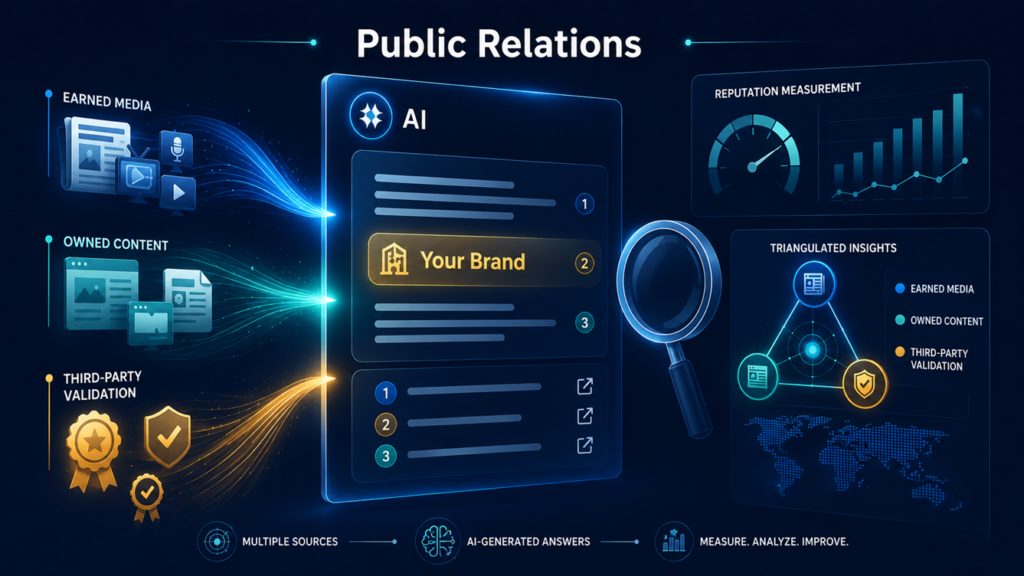
GEO, or Generative Engine Optimization, is the practice of improving and measuring how accurately, clearly, and prominently a brand appears in AI-generated answers. For PR and media intelligence teams, GEO matters because AI systems are becoming a new discovery layer where reputation is formed, summarized, compared, and sometimes misunderstood.
The simple question is this: when someone asks an AI tool about your company, category, issue, product, service, leader, or competitors, does the answer reflect the reputation you are trying to build? The measurement question goes one step further: what evidence shows that AI visibility is accurate, credible, consistent, and connected to meaningful outcomes?
Why GEO now belongs in PR measurement
For years, PR measurement has focused on coverage, reach, quality, message pull-through, share of voice, sentiment, authority, and business outcomes. Those measures still matter. The difference is that more people now use AI tools as front doors to information, which means brands are increasingly judged by the answer, not only by the article, search result, or social post behind it.
A CommPRO article on GEO and PR frames this shift as a communications opportunity, because earned media and trusted third-party sources influence what AI systems interpret, cite, and synthesize. AMEC adds the measurement discipline, advising practitioners to evaluate GEO through connected evidence instead of relying on one prompt, one tool, or one visibility score.
A unified definition for PR and measurement teams
GEO for PR measurement is the process of tracking whether AI systems find, understand, rely on credible signals about, and accurately present a brand in response to relevant questions.
It combines brand visibility, message accuracy, source credibility, content readiness, competitive context, and audience outcomes to show whether PR activity is shaping the answers people now receive from AI.
Two perspectives, one measurement challenge
The PR perspective: are AI tools telling the right story?
From a PR perspective, GEO matters because AI tools are becoming a new place where reputation is interpreted. PR teams need to know whether their brand is included, described correctly, supported by credible sources, and connected to the right topics.
- Is the brand included when people ask category-level questions?
- Is the brand described accurately and in the right context?
- Are executives and experts connected to the topics they should own?
- Are earned media, owned content, and third-party signals reinforcing the same story?
- Are AI tools recommending the brand, ignoring it, or misrepresenting it?
The measurement perspective: what evidence supports the answer?
From a measurement perspective, GEO should not be treated as one simple score. AI answers can change by platform, prompt, user context, market, language, retrieval method, and time. The stronger approach is to evaluate multiple evidence points and connect them to communications objectives.
This aligns with the logic of the AMEC Integrated Evaluation Framework and the Barcelona Principles 4.0, which emphasize meaningful, transparent, objective-led measurement rather than vanity metrics.
The three-part GEO measurement model
A practical GEO measurement program should connect three areas. Treat them as a triangle, not a ladder. None of the three tells the whole story alone.
| Measurement Area | What It Means | What To Measure |
| Downstream AI outputs | What people actually see when AI tools answer a question. | Presence, prominence, framing, source mix, message accuracy, and risk flags. |
| Upstream reputation | The public information environment AI tools may draw from or retrieve from. | Earned media, reviews, analyst commentary, thought leadership, social content, newsroom pages, FAQs, and executive bios. |
| Search and content readiness | Whether the brand content is findable, structured, current, and credible. | Crawlability, clear headings, question-based formats, freshness, authority, internal links, and credible inbound links. |
This three-part structure is drawn from AMEC guidance on GEO measurement, which recommends evaluating downstream AI outputs, upstream reputation, and search and content readiness together. The key discipline is triangulation, which keeps teams from treating a single AI answer as proof of impact.
GEO terms for PR professionals and PR measurement (Simplified)
- AI Visibility: Whether the brand appears in AI-generated answers. For PR teams, this shows whether the brand is part of the conversation. For measurement teams, it is only the starting point.
- Presence: Whether the brand appears at all in an AI answer. This is the simplest visibility check.
- Prominence: How strongly the brand appears in the answer. A brand named early, explained clearly, or included as a recommended option has stronger prominence.
- Framing: How AI describes the brand, including tone, positioning, category fit, strengths, weaknesses, and context.
- Message Accuracy: Whether the AI answer gets the facts right, including the company description, products, services, leaders, markets, claims, and proof points.
- Source Mix: The sources AI tools cite, link to, or appear to rely on. This can include earned media, owned content, reviews, analyst commentary, partner references, and other third-party sources.
- Risk Flags: Errors, outdated claims, misleading comparisons, missing context, or incorrect associations in AI answers. Being visible but wrong is not success. It is reputation risk with better lighting.
- Upstream Reputation: The body of public information AI tools may draw from, including earned media, reviews, thought leadership, social content, newsroom pages, FAQs, bios, and PR-shaped content.
- Downstream AI Outputs: What users actually see in AI answers, including whether the brand appears, how visible it is, how it is framed, which sources are used, and whether the answer is accurate.
- Search and Content Readiness: Whether the brand content is easy for search engines and AI tools to find, read, understand, and trust.
- Earned Media: News coverage, interviews, trade articles, and third-party media mentions. In GEO, earned media matters because AI tools may use credible coverage as evidence.
- Owned Content: Content controlled by the brand, including website pages, newsroom content, FAQs, executive bios, blogs, reports, service pages, and product pages.
- Expert Commentary: Quotes, bylines, interviews, podcasts, conference remarks, and thought leadership from company leaders or subject-matter experts.
- Third-Party Validation: Independent proof that supports credibility, including awards, reviews, analyst mentions, partner references, backlinks, citations, and industry recognition.
- Branded Prompts: AI questions that include the brand name, such as “What does Company X do?” These show how AI explains the brand when the user already knows who to ask about.
- Unbranded Prompts: AI questions that do not include the brand name, such as “best providers for media intelligence” or “how should PR teams measure reputation?” These show category-level discovery.
- Audience Prompts: Questions written from the perspective of a specific audience, such as a buyer, journalist, investor, regulator, employee, or customer.
- Competitor Context: How the brand appears when compared with competitors, including whether it is included, omitted, ranked, mischaracterized, or positioned correctly.
- Market and Language Context: How AI answers vary by country, region, language, or market.
- Directional Evidence: GEO findings should be treated as useful signals, not absolute truth. AI retrieval and citation behavior can shift.
- Baseline: The starting point for GEO measurement. Reliable historical back-search is limited, so trend analysis starts when monitoring begins.
- Outputs: The communications activity and content the organization creates or influences, including coverage, expert commentary, owned pages, and thought leadership.
- Out-takes: What people may see and take away from AI environments, including mentions, citations, framing, message accuracy, and source use.
- Outcomes: Actions that may follow from AI visibility where measurable, such as referral traffic from AI platforms, engaged sessions, conversions, assisted conversions, inquiries, or other audience behaviors.
- Impact: The contribution GEO makes to broader organizational goals, such as reputation, trust, demand generation, issue management, policy influence, recruitment, or revenue.
- Triangulation: Evaluating GEO from multiple angles instead of relying on one prompt, one tool, one platform, or one score.
How Infoesearch would evaluate GEO inside a media intelligence program
For media intelligence providers, GEO is not a replacement for media monitoring or PR measurement. It is an additional evidence layer. The work is to connect AI answer visibility with the media, content, and reputation signals that may be shaping those answers.
This fits naturally with Infoesearch work around media monitoring and measurement optimization, human-in-command intelligence, and reliability in AI-driven media intelligence. The goal is not to create a black-box AI score. The goal is to build a defensible view of how reputation signals become AI answers.
A practical GEO measurement checklist
- Define the business and communications objectives before choosing prompts or tools.
- Separate branded prompts from unbranded category prompts.
- Include audience-specific prompts for buyers, journalists, investors, regulators, employees, and customers where relevant.
- Track competitors, not only your own brand.
- Measure presence, prominence, framing, message accuracy, source mix, and risk flags.
- Audit the sources that appear to shape AI answers, including earned, owned, shared, and third-party signals.
- Review search and content readiness, including crawlable pages, fresh content, FAQs, bios, structured headings, and internal links.
- Establish a baseline before a major campaign, issue, launch, or reputation event.
- Treat results as directional evidence unless supported by multiple signals.
- Connect GEO findings to outcomes where referral traffic, conversions, inquiries, or other behavior can be measured.
FAQ: GEO for PR measurement
What does GEO mean in PR?
GEO means measuring and improving how a brand appears in AI-generated answers. It helps PR teams understand whether AI systems describe the brand accurately and connect it to the right topics.
How is GEO different from SEO?
SEO focuses on visibility in traditional search results. GEO focuses on visibility, accuracy, credibility, and source use inside AI-generated answers. Strong search foundations still matter because many AI discovery tools use web search or hybrid retrieval.
What should PR teams measure in GEO?
PR teams should measure AI presence, prominence, framing, message accuracy, source mix, risk flags, content readiness, competitor context, and outcomes where referral traffic or conversions can be tracked.
Can GEO be measured with one score?
No. GEO should not be reduced to one score because AI answers vary by platform, prompt, user context, market, language, retrieval method, and time.
Why does GEO matter for media intelligence?
GEO expands media intelligence from coverage tracking to answer tracking. It helps determine whether media, content, and reputation signals are shaping what AI systems tell audiences.
How should a company start measuring GEO?
Start with a clear baseline. Build a prompt set around branded, unbranded, competitor, audience, market, and issue-based questions. Then track how answers change over time and connect those changes to communications activity and outcomes.
Simple bottom line
For PR professionals, GEO answers this question: are AI tools telling the right story about our brand?
For PR measurement professionals, GEO adds a second question: what evidence proves that AI visibility is accurate, credible, consistent, and connected to meaningful outcomes?
Together, GEO is not just about showing up in AI. It is about showing up correctly, being supported by credible sources, and understanding whether that visibility contributes to reputation, trust, and business impact.
Source note and helpful links
This article synthesizes the CommPRO explanation of GEO relevance to PR with AMEC guidance on GEO measurement, especially its three-part evaluation model of downstream AI outputs, upstream reputation, and search/content readiness. AMEC also stresses that GEO results should be treated as directional evidence and evaluated through triangulation rather than a single visibility score.
Additional useful references: AMEC resources, AMEC Integrated Evaluation Framework, Barcelona Principles 4.0, and Infoesearch articles on media analysis.

Todd Murphy
Executive Director-Global Media Insights
Infoesearch