
In my last post, I wrote about the need to optimize the 75 percent of work that is routine, process-heavy, and essential, so that your team can focus on the top 25 percent where your true differentiation lives.
That raises an important question.
If you decide to optimize, who should you trust with that 75 percent?
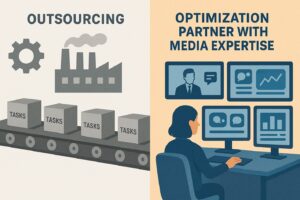
This is where many firms stumble. They treat optimization like generic outsourcing. They assume any service provider with enough people and a few tools can simply “take the work.” In media intelligence and media evaluation, that is a risky assumption. Even setting up your own outsourced solution adds a new layer of management and costs to your company, which is the opposite of optimization.
Our industry is different. The stakes are high. Clients rely on us not just for data, but for decisions that affect brand reputation, crisis response, and budget allocation. AMEC members and FIBEP members live in a world of standards, frameworks, and constant scrutiny.
So the partner who touches your processes needs more than cheap labor and shiny software. They need deep domain understanding.
Why Domain Expertise Matters
Media monitoring and media measurement are full of nuances that are invisible if you have not lived inside them.
A partner with real industry experience understands:
- The difference between “coverage” and “clarity,” and why both matter.
- How AMEC’s Integrated Evaluation Framework and the Barcelona Principles shape expectations for your reports and dashboards.
- Why a missed clip in a crisis, or a misclassified story in a quarterly analysis, can do real damage to your credibility with senior leaders.
- How FIBEP members structure their services, package their products, and talk about value to clients.
Most of the optimization value lives in the details. How you set up taxonomies. How you handle local languages. How you treat near-duplicates. How you embed quality checks into every step instead of relying on “final review” heroics.
A generic outsourcer might be able to follow a checklist. A media-intelligence-specific optimizer can help improve the checklist.
Optimization As Shared Craft, Not Just Transactions
At Infoesearch, our approach to MIPO and MAPO starts from the assumption that we are working inside a shared craft. Our institutional knowledge of both media intelligence process optimization and media analysis process optimization lets us deliver a truly optimized solution that makes your company better, not only more profitable
Our leaders and process designers have come from MMOs and media evaluation firms. We understand the pressures of daily news briefs, the expectations of measurement reports to have a validated framework, and the rhythms of election seasons, product launches, and crises.
That experience shapes how we design optimization:
- We structure stages 1, 2, and 3 so that they produce client-ready data for the type of reports, dashboards, and insights you present to boards and executives.
- We blend AI and human-in-command review in ways that respect the limits of automation and the realities of multilingual content.
- We design workflows that are compatible with the platforms, taxonomies, and evaluation models you already use, rather than forcing a “one size fits all” stack.
Optimization then becomes a partnership. Your team defines the strategy, methodology, and client-facing story. Our team builds and runs the engine that feeds that story, using best practices shaped by organizations like FIBEP and AMEC, and the difference-makers in those groups.
Guarding The 25 Percent That Makes You Unique
A good optimization partner is not interested in owning your client relationship. Instead, they are obsessed with protecting time and capacity for your Stage 4 work… that top 25%.
That means:
- Your analysts spend more hours interpreting results, not cleaning data.
- Your client leads have more time to speak with clients, not chase missing clips.
- Your leadership has more room to innovate because the operational base is stable and predictable.
- Your innovation and sales can grow because you’re saving money across 75% of operations.
The optimization partner succeeds when your brand gets stronger, your reports become more insightful, and your margins improve.
Questions To Ask Any Potential MIPO/MAPO Partner
If you are considering optimization in 2026, here are a few questions worth asking any outsourced provider:
- How many of your leaders have worked inside a media monitoring or measurement company?
- How do you align your workflows with AMEC principles and frameworks?
- What is your experience with FIBEP members and global media intelligence operations?
- How do you blend AI and human review to balance speed, quality, and risk?
- How do you ensure that Stage 4, the strategic client-facing layer, remains under our control?
The answers will tell you very quickly whether you are looking at a generic outsourcer or a true optimization partner.
The Future Belongs To The Optimizers
Our industry is moving fast. Costs are rising, expectations are high, and AI is changing the baseline.
The firms that will thrive in 2026 and beyond will not be the ones that simply work harder. They will be the ones that redesign how work gets done, and who choose partners that understand media intelligence as deeply as they do.
Optimization, done well, lets you deliver more value to clients, protect your people from burnout, and grow with confidence.
That is the future Infoesearch has built, together with MMOs and media evaluation firms around the world.
_
Todd Murphy
Executive Director – Global Media Insights
Infoesearch
