
If you run a media monitoring or media measurement service, you already feel it in your P&L.
Labor is more expensive. Benefits cost more. Licensing, AI tools, cloud storage, and security all keep ticking up. At the same time, clients still expect broader coverage, faster turnaround, deeper insight, and clearer links to outcomes. What they do not expect is a bigger invoice.
That growing gap between what it costs to deliver and what clients are willing to pay is now too wide to ignore. In 2026, it becomes a structural problem, not a seasonal one. For our industry, the answer is not “work harder.” It is “work differently.” This is where optimization comes in.
Outsourcing vs Optimization
For years, outsourcing mostly meant one thing: move work to a lower cost location and hope the spreadsheet looks better. The logic was simple. If you pay fewer dollars per hour, your total cost per report will go down. Sometimes that worked. Often, it created new problems. Misaligned expectations. Quality issues. Communication friction. A feeling that you had traded control for savings.
Optimization is different.
Optimization starts by asking, “What are the distinct stages of our service, and which of those stages truly define who we are as a company?”
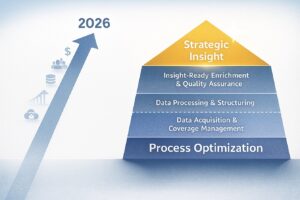
When I break down a typical media intelligence or evaluation workflow, I see four clear stages:
- Data Acquisition and Media Coverage Management
- Data Processing and Structuring
- Insight-Ready Enrichment and Quality Assurance
- Strategic Insight and High-Impact Delivery
Stages 1, 2, and 3 are essential. Without them, nothing works. They are also routine, rules-based, and highly repeatable. They take up a large share of your labor hours and operational costs, but they do not usually sit in your sales pitch.
Stage 4 is where the magic happens. This is where you design metrics, build narratives, connect coverage to outcomes, and sit across the table from clients as a trusted advisor. It is where your methodology, sector knowledge, and client relationships all show up. It is also where your margins should be strongest.
Optimization is about redesigning your operation around this reality.
The 75 Percent You Can Redesign
Most firms I speak with still have analysts and client-facing staff spending a lot of time in stages 1 to 3. They are checking captures, cleaning data, wrangling taxonomies, and formatting content for reports, while also trying to interpret results and advise clients.
In a cost environment like 2026, this mixed workload is a hidden tax on your business.
An optimization mindset says:
- Let us industrialize the routine 75 percent of the work, using a partner that focuses on process excellence, automation, and human-in-command quality checks.
- Let us protect and elevate the top 25 percent, where your team provides strategic insight, custom evaluation models, and executive storytelling.
This is not about replacing your team. It is about repositioning your team so that their time is spent where it creates the most value for clients and for your business.
Why 2026 Forces The Issue
Several forces are colliding at the same time.
- Structural cost increases. Salaries, benefits, and licenses are not going down.
- Client expectations. Today’s clients want integrated frameworks, multi-channel coverage, and clear “so what” and “what next” answers.
- AI as the new baseline. Generative AI and automation are now built into many tools your competitors use.
- Talent expectations. The best analysts want to think, not copy and paste.
If we keep the old model, we ask our teams to do everything at once. They become generalists who are stretched thin, and the business pays premium rates for a lot of work that could be handled more efficiently. Optimization creates a smarter division of labor. The partner focuses on repeatable process excellence. You focus on client strategy and innovation.
Designing Your Own Optimized Model
So how do you get started?
- Map your four stages. Be honest about where your hours really go in each one.
- Identify the routine work. Any task that is rules-based, repeatable, and measurable is a candidate for optimization.
- Protect your genius zone. Define the parts of Stage 4 that must always remain in-house because they represent your unique value.
- Set a 75 percent goal. Ask, “What would it take for us to deliver the same (or better) outcomes while optimizing 75 percent of the labor involved?”
In my next post, I will talk more about what makes an optimization partner valuable and why deep media intelligence experience matters.
For now, the key point is this:
2026 will reward the firms that redesign their operations before they are forced to. Optimization is not simply a cheaper labor location. It is a smarter operating model that lets you meet industry-level expectations while protecting your margins and your people… or better yet, growing your margins and your people’s skills.
_
Todd Murphy
Executive Director – Global Media Insights
Infoesearch
